Leave-One-Out Analysis#
This notebook demonstrates how to use the leave-one-out cross validation analysis of Wellbanks et al. 2023.
We compare two transmission retrievals of the same HST spectrum:a baseline free-chemistry model with CH4, CO2, and CO, and the same model with H2O added back in. Both retrievals use the Dynesty backend and the same forward model. The custom retrieval_model_spec_iso function now accepts a ModelContext and PhysicalParams, and it is explicitly marked as a differentiable retrieval model so Dynesty can use the JAX-aware runtime path.
In this tutorial:#
Running a transmission retrieval using Dynesty
Defining a custom model generating function
Performing leave-one-out cross validation analysis
[1]:
import os
from pathlib import Path

os.environ.setdefault("OMP_NUM_THREADS", "1")

import jax
jax.config.update("jax_enable_x64", True)
import jax.numpy as jnp
import matplotlib as mpl
import numpy as np
import matplotlib.pyplot as plt
import tensorflow_probability.substrates.jax as tfp

import petitRADTRANS as prt
from petitRADTRANS import physical_constants as cst
from petitRADTRANS.chemistry import clouds
from petitRADTRANS.chemistry.core import get_abundances
from petitRADTRANS.retrieval import Retrieval, RetrievalConfig
from petitRADTRANS.retrieval.models import (
    MODEL_CONTRACT_DIFFERENTIABLE,
    _compute_gravity,
    calculate_transmission_spectrum_runtime,
    initialize_pressure,
 )
from petitRADTRANS.retrieval.runtime import (
    ModelContext,
    ModelInputs,
    ModelResult,
    PhysicalParams,
    _radtrans_wavelength_grid,
 )
from petitRADTRANS.temperature_profiles import isothermal_temperature_profile

tfpd = tfp.distributions
[ ]:
package_root = Path(prt.__file__).resolve().parent
repo_root = package_root.parent
example_data_file = Path("retrievals/transmission/observations/HST/hst_example_clear_spec.txt")

output_root = repo_root / "retrieval_outputs" / "leave_one_out_dynesty"
output_root.mkdir(parents=True, exist_ok=True)

observations = np.loadtxt(example_data_file.resolve())
wavelengths = observations[:, 0]
spectrum = observations[:, 1]
uncertainties = observations[:, 2]
wavelength_boundaries = (
    0.95 * float(wavelengths.min()),
    1.05 * float(wavelengths.max()),
)

print(f"Example data: {example_data_file}")
print(f"Output directory: {output_root}")
print(
    f"Wavelength coverage: {wavelengths.min():.3f} to {wavelengths.max():.3f} micron"
)
print(f"Number of data points: {wavelengths.size}")
Example data: /Users/nasedkin/python-packages/petitRADTRANS/docs/content/notebooks/retrievals/transmission/observations/HST/hst_example_clear_spec.txt
Output directory: /Users/nasedkin/python-packages/petitRADTRANS/retrieval_outputs/leave_one_out_dynesty
Wavelength coverage: 1.138 to 1.637 micron
Number of data points: 20
Differentiable model functions#
In pRT4, custom retrieval models should follow the differentiable signature:
def retrieval_model_spec_iso(
    model_context: ModelContext,
    physical_params: PhysicalParams,
    pt_plot_mode: bool = False,
 ) -> ModelResult:
    ...
The example below expands the same steps used inside the built-in isothermal_transmission model:
initialize the pressure grid,
build the isothermal temperature profile,
compute abundances and mean molecular weights with
get_abundances,set up simple cloud and haze controls,
assemble
ModelInputs,call the transmission-spectrum calculator.
[3]:
def retrieval_model_spec_iso(
    model_context: ModelContext,
    physical_params: PhysicalParams,
    pt_plot_mode: bool = False,
 ) -> ModelResult:
    """Isothermal transmission model.

    This mirrors the main stages inside the built-in
    ``isothermal_transmission`` implementation so that users can adapt the
    pattern for their own transmission forward models.
    """
    p_use, p_global = initialize_pressure(
        model_context.radtrans.pressures / 1e6,
        physical_params,
        model_context.adaptive_mesh_refinement,
    )

    reference_pressure = 100.0
    if "reference_pressure" in physical_params.keys():
        reference_pressure = physical_params["reference_pressure"]

    temperatures = isothermal_temperature_profile(
        p_use,
        physical_params["temperature"],
    )
    gravity, planet_radius = _compute_gravity(physical_params)

    abundances, mean_molar_masses, small_index, _p_bases = get_abundances(
        pressures=p_use,
        temperatures=temperatures,
        parameters=physical_params,
        line_species=model_context.radtrans.line_species,
        cloud_species=model_context.radtrans.cloud_species,
        adaptive_mesh_refinement=model_context.adaptive_mesh_refinement,
    )

    if abundances is None:
        wavelengths = _radtrans_wavelength_grid(model_context.radtrans)
        return ModelResult.make_nan_result(wavelengths)

    if pt_plot_mode:
        return ModelResult(
            kind="pt_profile",
            pressures=p_use[small_index],
            temperatures=temperatures[small_index],
        )

    if model_context.adaptive_mesh_refinement:
        temperatures = temperatures[small_index]
        pressures = p_global[small_index]
        mean_molar_masses = mean_molar_masses[small_index]
        model_context.radtrans.pressures = pressures * 1e6
    else:
        pressures = p_use

    if pressures.shape[0] != model_context.radtrans.pressures.shape[0]:
        wavelengths = _radtrans_wavelength_grid(model_context.radtrans)
        return ModelResult.make_nan_result(wavelengths)

    pcloud, power_law_opacity_coefficient, haze_factor, power_law_opacity_350nm = (
        clouds.setup_simple_clouds_hazes(physical_params)
    )
    cloud_properties = clouds.setup_clouds(
        pressures,
        physical_params,
        model_context.radtrans.cloud_species,
    )
    (
        sigma_lnorm,
        cloud_f_sed,
        eddy_diffusion_coefficients,
        cloud_hansen_b,
        cloud_particle_mean_radii,
        cloud_fraction,
        patchy_clouds,
        distribution,
    ) = cloud_properties

    model_inputs = ModelInputs(
        pressures=pressures,
        temperatures=temperatures,
        abundances=abundances,
        mean_molar_masses=mean_molar_masses,
        gravity=gravity,
        planet_radius=planet_radius,
        reference_pressure=reference_pressure,
        opaque_cloud_top_pressure=pcloud,
        sigma_lnorm=sigma_lnorm,
        cloud_particle_mean_radii=cloud_particle_mean_radii,
        cloud_f_sed=cloud_f_sed,
        eddy_diffusion_coefficients=eddy_diffusion_coefficients,
        haze_factor=haze_factor,
        power_law_opacity_coefficient=power_law_opacity_coefficient,
        power_law_opacity_350nm=power_law_opacity_350nm,
        cloud_hansen_b=cloud_hansen_b,
        cloud_fraction=cloud_fraction,
        patchy_clouds=patchy_clouds,
        cloud_particle_radius_distribution=distribution,
        stellar_radius=physical_params["stellar_radius"],
    )

    return calculate_transmission_spectrum_runtime(
        model_context,
        model_inputs,
    )

setattr(
    retrieval_model_spec_iso,
    "_prt_model_contract",
    MODEL_CONTRACT_DIFFERENTIABLE,
 )
Retrieval configuration helper#
Both retrievals share the same physical parameters, data file, and Dynesty configuration. The only difference is the set of retrieved line species. We build both RetrievalConfig objects from one helper so the comparison stays controlled.
[12]:
pressures = jnp.logspace(-6.0, 2.0, 100)

corner_labels = {
    "1H2-16O__POKAZATEL": r"$\log X_{\rm H_2O}$",
    "12C-1H4__HITEMP": r"$\log X_{\rm CH_4}$",
    "12C-16O2__UCL-4000": r"$\log X_{\rm CO_2}$",
    "C-O-NatAbund__HITEMP": r"$\log X_{\rm CO}$",
}

def build_leave_one_out_config(retrieval_name, line_species):
    retrieval_config = RetrievalConfig(
        retrieval_name=retrieval_name,
        run_mode="evaluate",
        sampler_type="dynesty",
        pressures=pressures,
        adaptive_mesh_refinement=False,
        scattering_in_emission=False,
    )

    retrieval_config.add_parameter(
        name="stellar_radius",
        is_free_parameter=False,
        value=0.651 * cst.r_sun,
        plot_in_corner=False,
    )
    retrieval_config.add_parameter(
        name="reference_pressure",
        is_free_parameter=False,
        value=0.01,
        plot_in_corner=False,
    )
    retrieval_config.add_parameter(
        name="log_g",
        is_free_parameter=True,
        distribution=tfpd.Uniform(low=2.0, high=5.5),
        plot_in_corner=True,
        corner_ranges=(2.0, 5.5),
        corner_label=r"$\log(g)$",
    )
    retrieval_config.add_parameter(
        name="planet_radius",
        is_free_parameter=True,
        distribution=tfpd.Uniform(
            low=0.1 * cst.r_jup_mean,
            high=0.4 * cst.r_jup_mean,
        ),
        plot_in_corner=True,
        corner_ranges=(0.1, 0.4),
        corner_label=r"$R_{\rm P}$ ($R_{\rm Jup}$)",
        corner_transform=lambda radius: radius / cst.r_jup_mean,
    )
    retrieval_config.add_parameter(
        name="temperature",
        is_free_parameter=True,
        distribution=tfpd.Uniform(low=300.0, high=2000.0),
        plot_in_corner=True,
        corner_ranges=(300.0, 2000.0),
        corner_label="Temperature [K]",
    )
    retrieval_config.add_parameter(
        name="log_Pcloud",
        is_free_parameter=True,
        distribution=tfpd.Uniform(low=-6.0, high=2.0),
        plot_in_corner=True,
        corner_ranges=(-6.0, 2.0),
        corner_label=r"$\log P_{\rm cloud}$",
    )

    retrieval_config.set_rayleigh_species(["H2", "He"])
    retrieval_config.set_continuum_opacities(["H2--H2", "H2--He"])
    retrieval_config.set_line_species(
        list(line_species),
        use_equilibrium_chemistry=False,
        free_mass_fraction_limits=(-6.0, 0.0),
        plot_in_corner=True,
    )

    for species in retrieval_config.line_species:
        retrieval_config.parameters[species].corner_label = corner_labels.get(
            species, species
        )
        retrieval_config.parameters[species].corner_ranges = (-6.2, 0.2)

    retrieval_config.add_data(
        name="HST",
        path_to_observations=str(example_data_file),
        model_generating_function=retrieval_model_spec_iso,
        data_resolution=60,
        model_resolution=120,
        wavelength_boundaries=wavelength_boundaries,
        line_opacity_mode="c-k",
    )

    return retrieval_config
[13]:
line_species_no_h2o = (
    "12C-1H4__HITEMP",
    "12C-16O2__UCL-4000",
    "C-O-NatAbund__HITEMP",
)
line_species_with_h2o = (
    "1H2-16O__POKAZATEL",
    *line_species_no_h2o,
 )

retrieval_config_no_h2o = build_leave_one_out_config(
    "hst_example_clear_spec_no_h2o_v4",
    line_species_no_h2o,
 )
retrieval_config_h2o = build_leave_one_out_config(
    "hst_example_clear_spec_with_h2o_v4",
    line_species_with_h2o,
 )

print("No-H2O retrieval line species:", retrieval_config_no_h2o.line_species)
print("H2O retrieval line species:", retrieval_config_h2o.line_species)
No-H2O retrieval line species: ('12C-1H4__HITEMP', '12C-16O2__UCL-4000', 'C-O-NatAbund__HITEMP')
H2O retrieval line species: ('1H2-16O__POKAZATEL', '12C-1H4__HITEMP', '12C-16O2__UCL-4000', 'C-O-NatAbund__HITEMP')
[14]:
retrieval_no_h2o = Retrieval(
    configuration=retrieval_config_no_h2o,
    output_directory=str(output_root),
    evaluate_sample_spectra=False,
    reference_data_name="HST",
    use_prt_plot_style=True,
 )

retrieval_h2o = Retrieval(
    configuration=retrieval_config_h2o,
    output_directory=str(output_root),
    evaluate_sample_spectra=False,
    reference_data_name="HST",
    use_prt_plot_style=True,
 )

for retrieval in (retrieval_no_h2o, retrieval_h2o):
    retrieval.plotter.spec_xlabel = "Wavelength [micron]"
    retrieval.plotter.spec_ylabel = r"$(R_{\rm P}/R_*)^2$ [ppm]"
    retrieval.plotter.y_axis_scaling = 1e6
    retrieval.plotter.xscale = "linear"
    retrieval.plotter.yscale = "linear"
    retrieval.plotter.reference_data_name = "HST"
    retrieval.plotter.temp_limits = [150, 3000]
    retrieval.plotter.press_limits = [1e1, 1e-6]

runtime = retrieval_h2o._get_runtime()
for group in runtime.model_groups:
    print(
        {
            "source_name": group.source_name,
            "model_contract": group.model_contract,
            "observation_names": group.observation_names,
        }
    )
Setting up Radtrans object for data 'HST'...
Loading Radtrans opacities...
 Loading line opacities of species '12C-1H4__HITEMP.R120' from file '/Users/nasedkin/python-packages/petitRADTRANS/input_data/opacities/lines/correlated_k/CH4/12C-1H4/12C-1H4__HITEMP.R120_0.1-250mu.ktable.petitRADTRANS.h5'... Done.
 Loading line opacities of species '12C-16O2__UCL-4000.R120' from file '/Users/nasedkin/python-packages/petitRADTRANS/input_data/opacities/lines/correlated_k/CO2/12C-16O2/12C-16O2__UCL-4000.R120_0.3-50mu.ktable.petitRADTRANS.h5'... Done.
 Loading line opacities of species 'C-O-NatAbund__HITEMP.R120' from file '/Users/nasedkin/python-packages/petitRADTRANS/input_data/opacities/lines/correlated_k/CO/C-O-NatAbund/C-O-NatAbund__HITEMP.R120_0.1-250mu.ktable.petitRADTRANS.h5'... Done.
 Successfully loaded all line opacities
 Loading CIA opacities for H2--H2 from file '/Users/nasedkin/python-packages/petitRADTRANS/input_data/opacities/continuum/collision_induced_absorptions/H2--H2/H2--H2-NatAbund/H2--H2-NatAbund__BoRi.R831_0.6-250mu.ciatable.petitRADTRANS.h5'... Done.
 Loading CIA opacities for H2--He from file '/Users/nasedkin/python-packages/petitRADTRANS/input_data/opacities/continuum/collision_induced_absorptions/H2--He/H2--He-NatAbund/H2--He-NatAbund__BoRi.DeltaWavenumber2_0.5-500mu.ciatable.petitRADTRANS.h5'... Done.
 Successfully loaded all CIA opacities
Successfully loaded all opacities
Best fit likelihood = 166.78
Setting up Radtrans object for data 'HST'...
Loading Radtrans opacities...
 Loading line opacities of species '1H2-16O__POKAZATEL.R120' from file '/Users/nasedkin/python-packages/petitRADTRANS/input_data/opacities/lines/correlated_k/H2O/1H2-16O/1H2-16O__POKAZATEL.R120_0.3-50mu.ktable.petitRADTRANS.h5'... Done.
 Loading line opacities of species '12C-1H4__HITEMP.R120' from file '/Users/nasedkin/python-packages/petitRADTRANS/input_data/opacities/lines/correlated_k/CH4/12C-1H4/12C-1H4__HITEMP.R120_0.1-250mu.ktable.petitRADTRANS.h5'... Done.
 Loading line opacities of species '12C-16O2__UCL-4000.R120' from file '/Users/nasedkin/python-packages/petitRADTRANS/input_data/opacities/lines/correlated_k/CO2/12C-16O2/12C-16O2__UCL-4000.R120_0.3-50mu.ktable.petitRADTRANS.h5'... Done.
 Loading line opacities of species 'C-O-NatAbund__HITEMP.R120' from file '/Users/nasedkin/python-packages/petitRADTRANS/input_data/opacities/lines/correlated_k/CO/C-O-NatAbund/C-O-NatAbund__HITEMP.R120_0.1-250mu.ktable.petitRADTRANS.h5'... Done.
 Successfully loaded all line opacities
 Loading CIA opacities for H2--H2 from file '/Users/nasedkin/python-packages/petitRADTRANS/input_data/opacities/continuum/collision_induced_absorptions/H2--H2/H2--H2-NatAbund/H2--H2-NatAbund__BoRi.R831_0.6-250mu.ciatable.petitRADTRANS.h5'... Done.
 Loading CIA opacities for H2--He from file '/Users/nasedkin/python-packages/petitRADTRANS/input_data/opacities/continuum/collision_induced_absorptions/H2--He/H2--He-NatAbund/H2--He-NatAbund__BoRi.DeltaWavenumber2_0.5-500mu.ciatable.petitRADTRANS.h5'... Done.
 Successfully loaded all CIA opacities
Successfully loaded all opacities
Best fit likelihood = 172.32
{'source_name': 'HST', 'model_contract': 'differentiable', 'observation_names': ('HST',)}
Running the Dynesty retrievals#
The cells below keep both retrievals disabled by default so that opening the notebook does not start nested sampling automatically. Set the flags to True when you want to run or resume the two fits.
[15]:
run_no_h2o_retrieval = True
run_h2o_retrieval = True

def run_dynesty_retrieval(retrieval):
    return retrieval.run(
        nlive=40,
        dlogz_init=0.5,
        bound="multi",
        sample="rwalk",
        use_jit=True,
        resume=True,
    )

if run_no_h2o_retrieval:
    run_dynesty_retrieval(retrieval_no_h2o)

if run_h2o_retrieval:
    run_dynesty_retrieval(retrieval_h2o)
Loading saved retrieval results for hst_example_clear_spec_no_h2o_v4 with dynesty
Loading saved retrieval results for hst_example_clear_spec_with_h2o_v4 with dynesty
Loading posterior samples#
Once the Dynesty runs finish, the helper below reloads the equal-weight posterior samples from out_Dynesty. If the files do not exist yet, the notebook prints a message and the later diagnostics cells remain guarded.
[16]:
def load_results_if_available(retrieval):
    ret_name = retrieval.configuration.retrieval_name
    dynesty_dir = Path(retrieval.output_directory) / "out_Dynesty"
    samples_path = dynesty_dir / f"{ret_name}_samples.npz"
    params_path = dynesty_dir / f"{ret_name}_params.json"

    if not samples_path.exists() or not params_path.exists():
        print(f"Missing Dynesty outputs for {ret_name}.")
        return None, None, None, None

    sample_dict, parameter_dict = retrieval.get_samples(
        output_directory=retrieval.output_directory
    )
    return (
        sample_dict,
        parameter_dict,
        sample_dict[ret_name],
        parameter_dict[ret_name],
    )

(
    sample_dict_no_h2o,
    parameter_dict_no_h2o,
    samples_no_h2o,
    parameters_no_h2o,
 ) = load_results_if_available(retrieval_no_h2o)

(
    sample_dict_h2o,
    parameter_dict_h2o,
    samples_h2o,
    parameters_h2o,
 ) = load_results_if_available(retrieval_h2o)
Computing leave-one-out diagnostics#
get_elpd_per_datapoint() reads per-datapoint log-likelihood arrays from the evaluation folders. We therefore regenerate those arrays first for each retrieval, and then compare the H2O and no-H2O runs on the same data set.
[ ]:
elpd_tot, elpd, pareto_k, delta_elpd = None, None, None, None

if samples_no_h2o is not None and samples_h2o is not None:
    samples_no_h2o = samples_no_h2o.T # Transpose to shape (num_samples, num_parameters + 1)
    samples_h2o = samples_h2o.T
    retrieval_no_h2o.get_log_likelihood_per_datapoint(
        samples_no_h2o[:,:-1],
        ret_name=retrieval_no_h2o.configuration.retrieval_name,
    )
    retrieval_h2o.get_log_likelihood_per_datapoint(
        samples_h2o[:,:-1],
        ret_name=retrieval_h2o.configuration.retrieval_name,
    )

    comparison_names = [
        retrieval_h2o.configuration.retrieval_name,
        retrieval_no_h2o.configuration.retrieval_name,
    ]
    elpd_tot, elpd, pareto_k, delta_elpd = retrieval_h2o.get_elpd_per_datapoint(
        ret_name=comparison_names,  # pyright: ignore[reportArgumentType]
    )

    for data_name, totals in elpd_tot.items():
        print(f"{data_name}:")
        print("  total ELPD:", totals)
else:
    print(
        "Run both retrievals, or place existing Dynesty outputs in the configured output directory, "
        "before computing leave-one-out diagnostics."
    )
HST:
  total ELPD: {'hst_example_clear_spec_with_h2o_v4': np.float64(169.749688749485), 'hst_example_clear_spec_no_h2o_v4': np.float64(163.29783412163334)}
Plotting the best-fit spectrum#
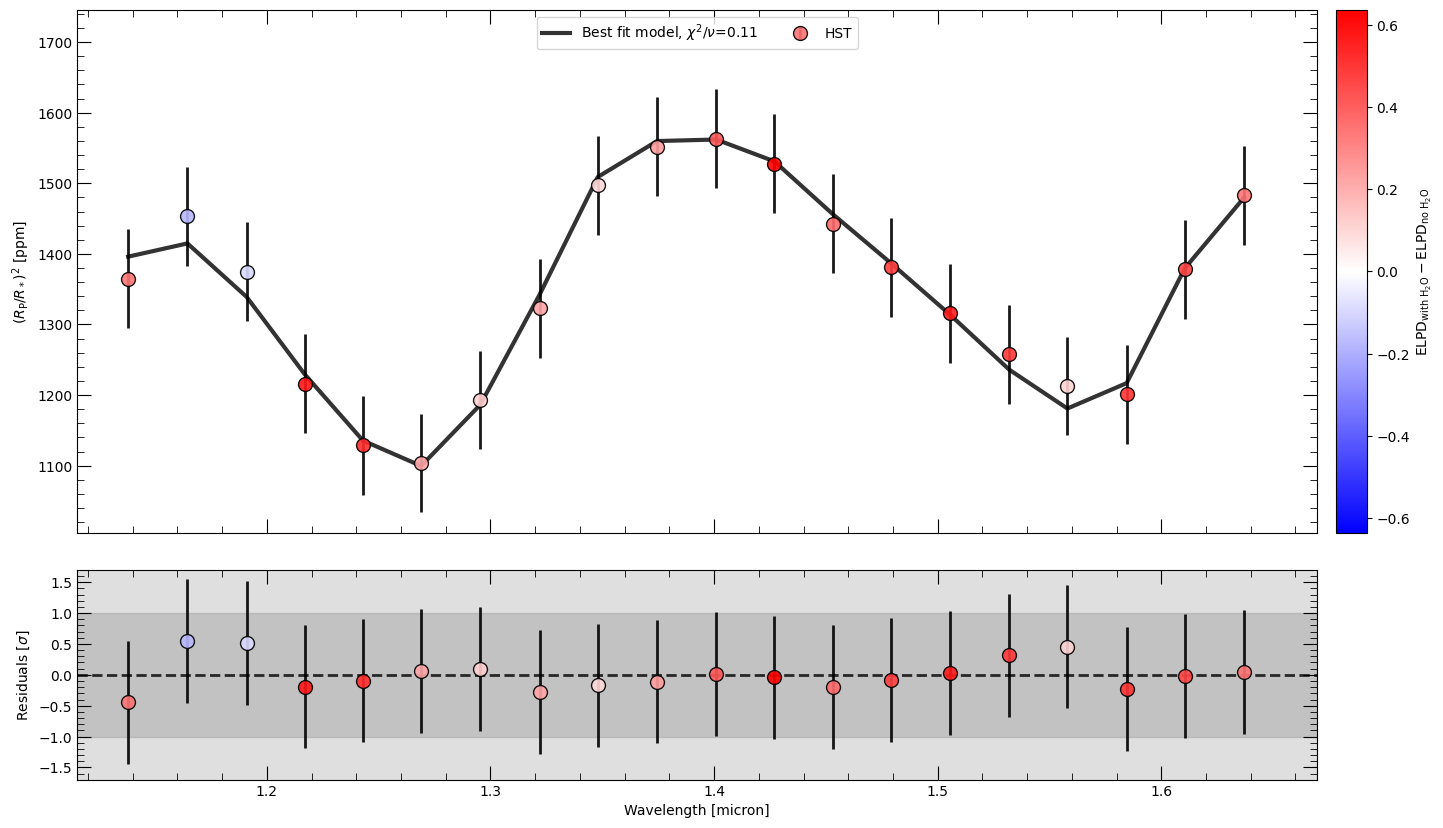
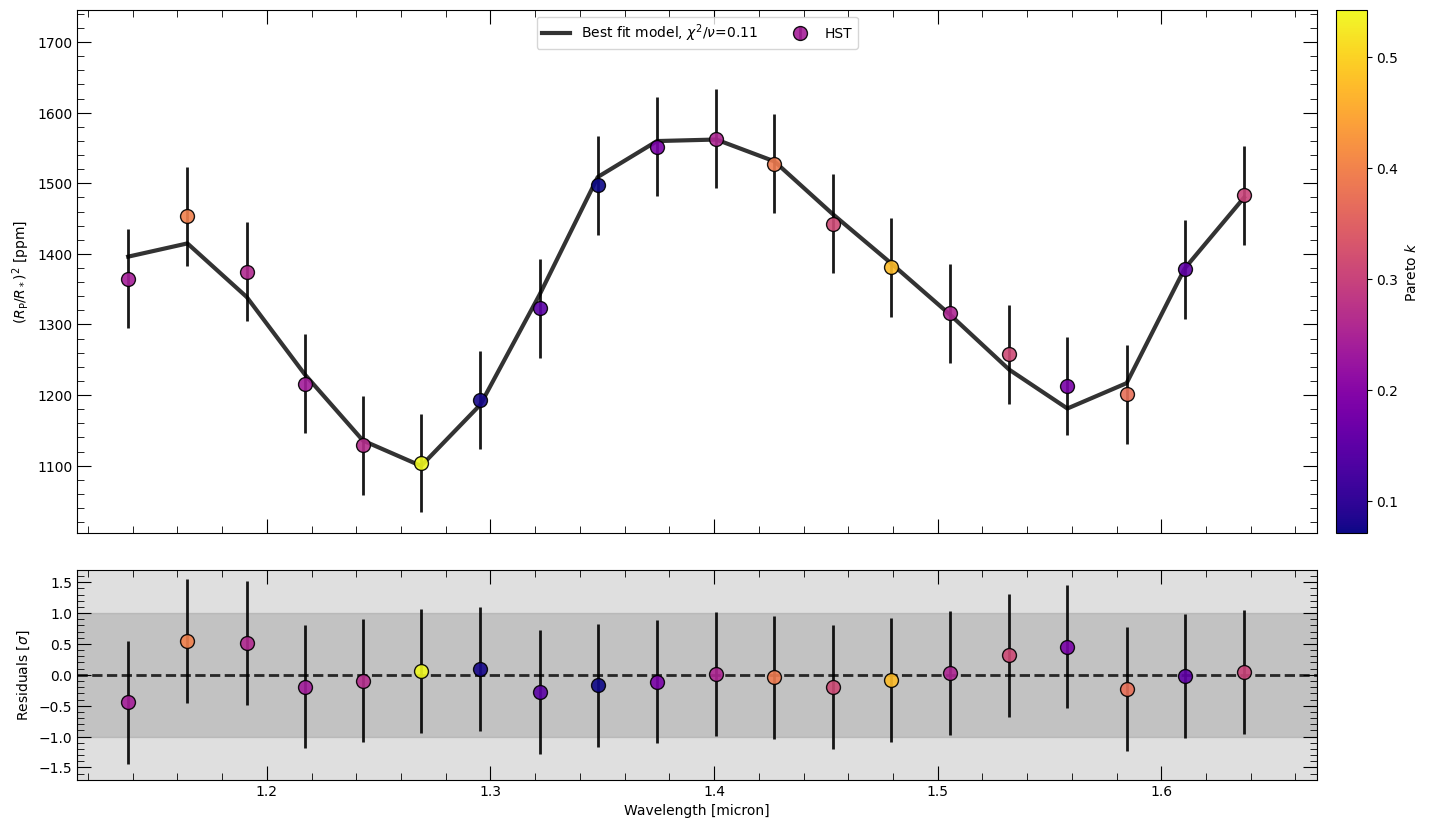
The two plots below color the data points by the Pareto-k diagnostic and by the per-point ELPD difference between the H2O and no-H2O retrievals.
[ ]:
if samples_h2o is not None and parameters_h2o is not None and pareto_k is not None:
    fig, ax, ax_r = retrieval_h2o.plot_spectra(
        samples_h2o.T, # Transpose back to shape (num_parameters + 1, num_samples) for plotting
        parameters_h2o,
        refresh=True,
        mode="bestfit",
        marker_color_type="pareto_k",
        marker_cmap=mpl.colormaps["plasma"],
        marker_label=r"Pareto $k$",
    )
    plt.show()
else:
    print(
        "Pareto-k plotting is available after the H2O retrieval results have been loaded."
    )
Plotting Best-fit spectrum
Best fit likelihood = 172.32
Loading Radtrans opacities...
 Loading line opacities of species '1H2-16O__POKAZATEL.R120' from file '/Users/nasedkin/python-packages/petitRADTRANS/input_data/opacities/lines/correlated_k/H2O/1H2-16O/1H2-16O__POKAZATEL.R120_0.3-50mu.ktable.petitRADTRANS.h5'... Done.
 Loading line opacities of species '12C-1H4__HITEMP.R120' from file '/Users/nasedkin/python-packages/petitRADTRANS/input_data/opacities/lines/correlated_k/CH4/12C-1H4/12C-1H4__HITEMP.R120_0.1-250mu.ktable.petitRADTRANS.h5'... Done.
 Loading line opacities of species '12C-16O2__UCL-4000.R120' from file '/Users/nasedkin/python-packages/petitRADTRANS/input_data/opacities/lines/correlated_k/CO2/12C-16O2/12C-16O2__UCL-4000.R120_0.3-50mu.ktable.petitRADTRANS.h5'... Done.
 Loading line opacities of species 'C-O-NatAbund__HITEMP.R120' from file '/Users/nasedkin/python-packages/petitRADTRANS/input_data/opacities/lines/correlated_k/CO/C-O-NatAbund/C-O-NatAbund__HITEMP.R120_0.1-250mu.ktable.petitRADTRANS.h5'... Done.
 Successfully loaded all line opacities
 Loading CIA opacities for H2--H2 from file '/Users/nasedkin/python-packages/petitRADTRANS/input_data/opacities/continuum/collision_induced_absorptions/H2--H2/H2--H2-NatAbund/H2--H2-NatAbund__BoRi.R831_0.6-250mu.ciatable.petitRADTRANS.h5'... Done.
 Loading CIA opacities for H2--He from file '/Users/nasedkin/python-packages/petitRADTRANS/input_data/opacities/continuum/collision_induced_absorptions/H2--He/H2--He-NatAbund/H2--He-NatAbund__BoRi.DeltaWavenumber2_0.5-500mu.ciatable.petitRADTRANS.h5'... Done.
 Successfully loaded all CIA opacities
Successfully loaded all opacities
Best fit 𝛘^2 = 1.35
Best fit 𝛘^2/DoF = 0.11
/Users/nasedkin/python-packages/petitRADTRANS/petitRADTRANS/retrieval/plotting.py:1780: UserWarning: This figure includes Axes that are not compatible with tight_layout, so results might be incorrect.
  plt.tight_layout()
[23]:
if samples_h2o is not None and parameters_h2o is not None and delta_elpd is not None:
    fig, ax, ax_r = retrieval_h2o.plot_spectra(
        samples_h2o.T,
        parameters_h2o,
        refresh=True,
        mode="bestfit",
        marker_color_type="delta_elpd",
        marker_cmap=mpl.colormaps["bwr"],
        marker_label=(
            r"$\mathrm{ELPD}_{\mathrm{with\ H_2O}} - "
            r"\mathrm{ELPD}_{\mathrm{no\ H_2O}}$"
        ),
    )
    plt.show()
else:
    print(
        "Delta-ELPD plotting is available after leave-one-out diagnostics have been computed."
    )
Plotting Best-fit spectrum
Best fit likelihood = 172.32
Loading Radtrans opacities...
 Loading line opacities of species '1H2-16O__POKAZATEL.R120' from file '/Users/nasedkin/python-packages/petitRADTRANS/input_data/opacities/lines/correlated_k/H2O/1H2-16O/1H2-16O__POKAZATEL.R120_0.3-50mu.ktable.petitRADTRANS.h5'... Done.
 Loading line opacities of species '12C-1H4__HITEMP.R120' from file '/Users/nasedkin/python-packages/petitRADTRANS/input_data/opacities/lines/correlated_k/CH4/12C-1H4/12C-1H4__HITEMP.R120_0.1-250mu.ktable.petitRADTRANS.h5'... Done.
 Loading line opacities of species '12C-16O2__UCL-4000.R120' from file '/Users/nasedkin/python-packages/petitRADTRANS/input_data/opacities/lines/correlated_k/CO2/12C-16O2/12C-16O2__UCL-4000.R120_0.3-50mu.ktable.petitRADTRANS.h5'... Done.
 Loading line opacities of species 'C-O-NatAbund__HITEMP.R120' from file '/Users/nasedkin/python-packages/petitRADTRANS/input_data/opacities/lines/correlated_k/CO/C-O-NatAbund/C-O-NatAbund__HITEMP.R120_0.1-250mu.ktable.petitRADTRANS.h5'... Done.
 Successfully loaded all line opacities
 Loading CIA opacities for H2--H2 from file '/Users/nasedkin/python-packages/petitRADTRANS/input_data/opacities/continuum/collision_induced_absorptions/H2--H2/H2--H2-NatAbund/H2--H2-NatAbund__BoRi.R831_0.6-250mu.ciatable.petitRADTRANS.h5'... Done.
 Loading CIA opacities for H2--He from file '/Users/nasedkin/python-packages/petitRADTRANS/input_data/opacities/continuum/collision_induced_absorptions/H2--He/H2--He-NatAbund/H2--He-NatAbund__BoRi.DeltaWavenumber2_0.5-500mu.ciatable.petitRADTRANS.h5'... Done.
 Successfully loaded all CIA opacities
Successfully loaded all opacities
Best fit 𝛘^2 = 1.35
Best fit 𝛘^2/DoF = 0.11
/Users/nasedkin/python-packages/petitRADTRANS/petitRADTRANS/retrieval/plotting.py:1780: UserWarning: This figure includes Axes that are not compatible with tight_layout, so results might be incorrect.
  plt.tight_layout()